


it’s 7pm and your baby is hilarious. bouncing, giggling, a fresh burst of energy out of nowhere. and you think what almost every parent thinks: look at her, she’s clearly not tired yet.
that energy is the tiredness. not a sign she’s fine. that’s the tiredness itself, standing up and putting on a show.
why an overtired baby looks wired, not tired
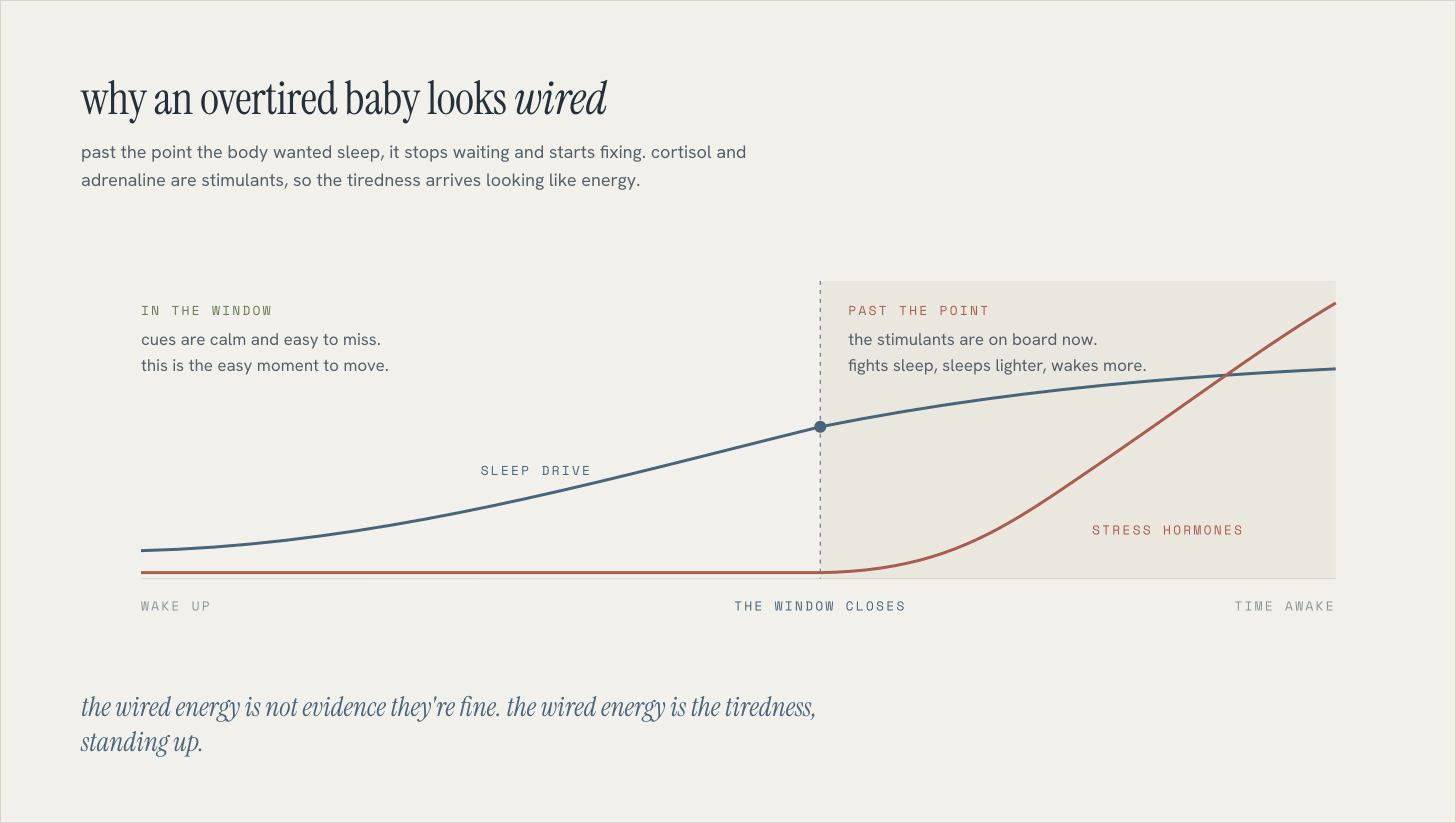
when a baby stays awake past the point their body wanted sleep, their body doesn’t quietly slow down and wait. it reads “still awake and running low” as a problem to solve, and it solves it by releasing cortisol and adrenaline. those are stimulants. so the more overtired a baby gets, the more wired they look, not less.
this is why “she’s not acting tired, so she must not be ready” is the most expensive misread in baby sleep. the wired energy is not evidence she’s fine. it’s the tiredness, dressed up as a second wind.
and it doesn’t stop at bedtime. those hormones don’t clear the second she finally goes down. so an overtired baby fights sleep harder, sleeps lighter once she’s under, wakes more through the night, and often fires the day up at 5am. one missed window doesn’t just echo, it compounds. the bad night wasn’t random. it was set in motion hours earlier, in daylight.
why the wake window number misleads you
so where does it come from, this instinct to keep going? almost always the same place. a number. the “wake windows by age” chart, the one that lives in every baby app and gets screenshotted from tiktok, read as a rule. “she needs to stay up two hours.” and now that chart is doing the one thing it should never do: overriding your own eyes.
a wake window is a range, not a rule, and it was built from hundreds of other babies’ averages. it has never met yours. it didn’t see how her nap went this morning. the chart doesn’t know your baby, and on the nights it disagrees with the kid in front of you, the kid is right.
overtired is preventable
overtired is preventable far more often than you’d think. not by watching the clock harder, but by watching your baby instead of the number. the parents who rarely deal with the 7pm meltdown aren’t running a better schedule. they’re reading their kid.
that’s the whole skill. everything below is how to do it.
or if you’d like to connect 1:1, start by filling out this form!
the signs of an overtired baby, in order
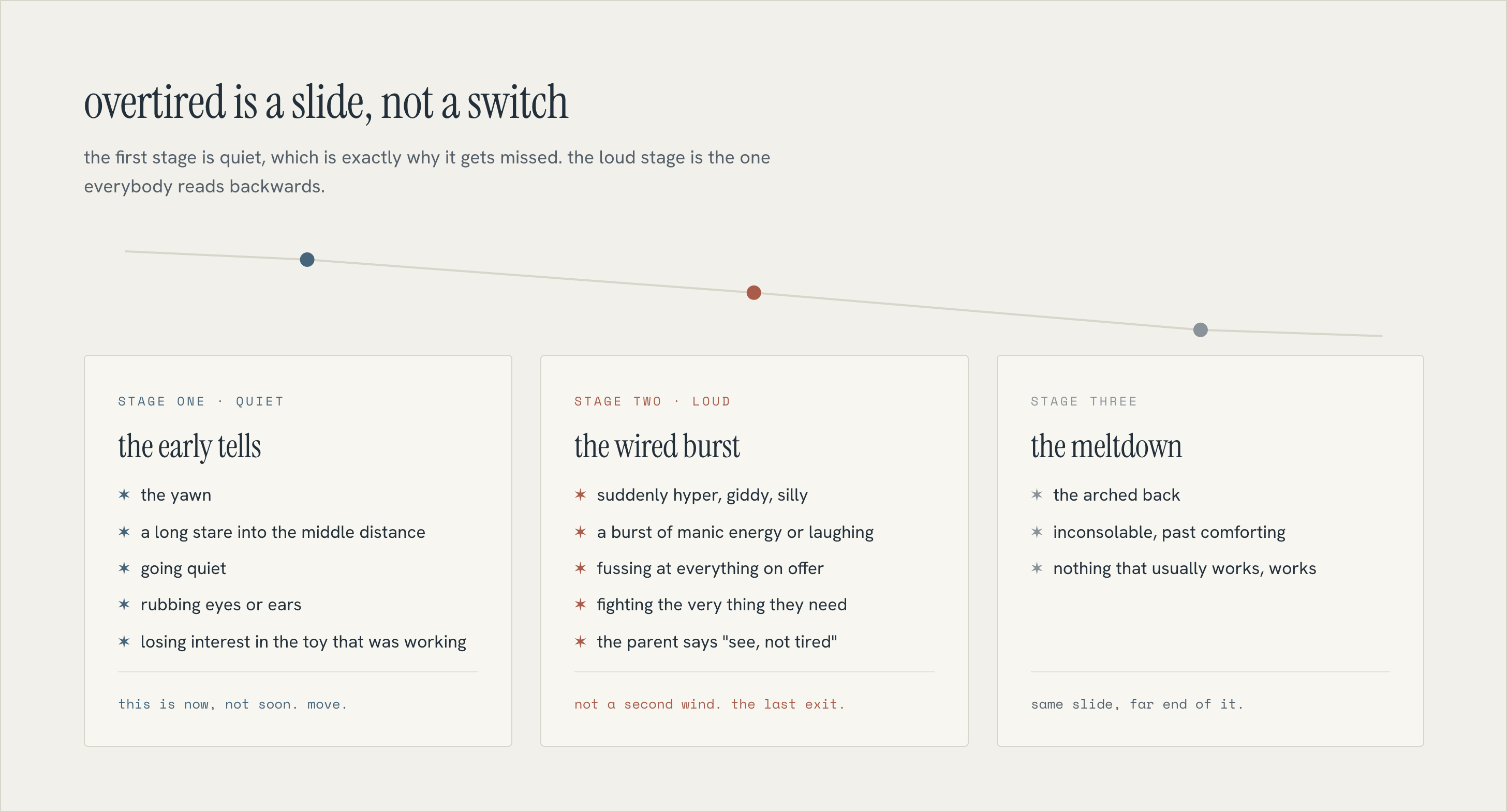
overtired isn’t a switch, it’s a slide, and it has stages you can learn to see.
the early tells are calm, which is exactly why they get missed. the yawn. the long stare into the middle distance. going quiet. rubbing eyes or ears. losing interest in the toy that was working a minute ago. this is the “put me down soon” window, and it’s easy to sail past because nothing about it looks urgent.
the second you see any of it, that’s not “soon.” that’s now. move, and cut short whatever you were about to do. for some babies the gap between the first tell and past-the-point is five or ten minutes, and it closes fast.
miss it and you get the loud stage. suddenly hyper, giddy, a burst of manic energy or laughing or fussing, fighting the very thing she needs. this is where parents say “see, not tired.” it’s the opposite. it’s the body’s rescue flare going up. past that is the full arched-back meltdown, which is just the far end of the same slide.
don’t read that burst as a second wind to ride out. it’s the last exit before the meltdown. get her down faster, not later. take it.
how to prevent an overtired baby
you prevent overtired far more often than you fix it. prevention is boring and unglamorous and it’s where the whole thing is won.
when you can’t decide, go early. when you genuinely can’t tell whether to put her down now or in fifteen minutes, put her down now. an undertired baby costs you twenty minutes of chatter in the crib. an overtired baby costs you the night. those two mistakes are not the same size, so stop treating them like they are. early is the cheap mistake. late is the expensive one.
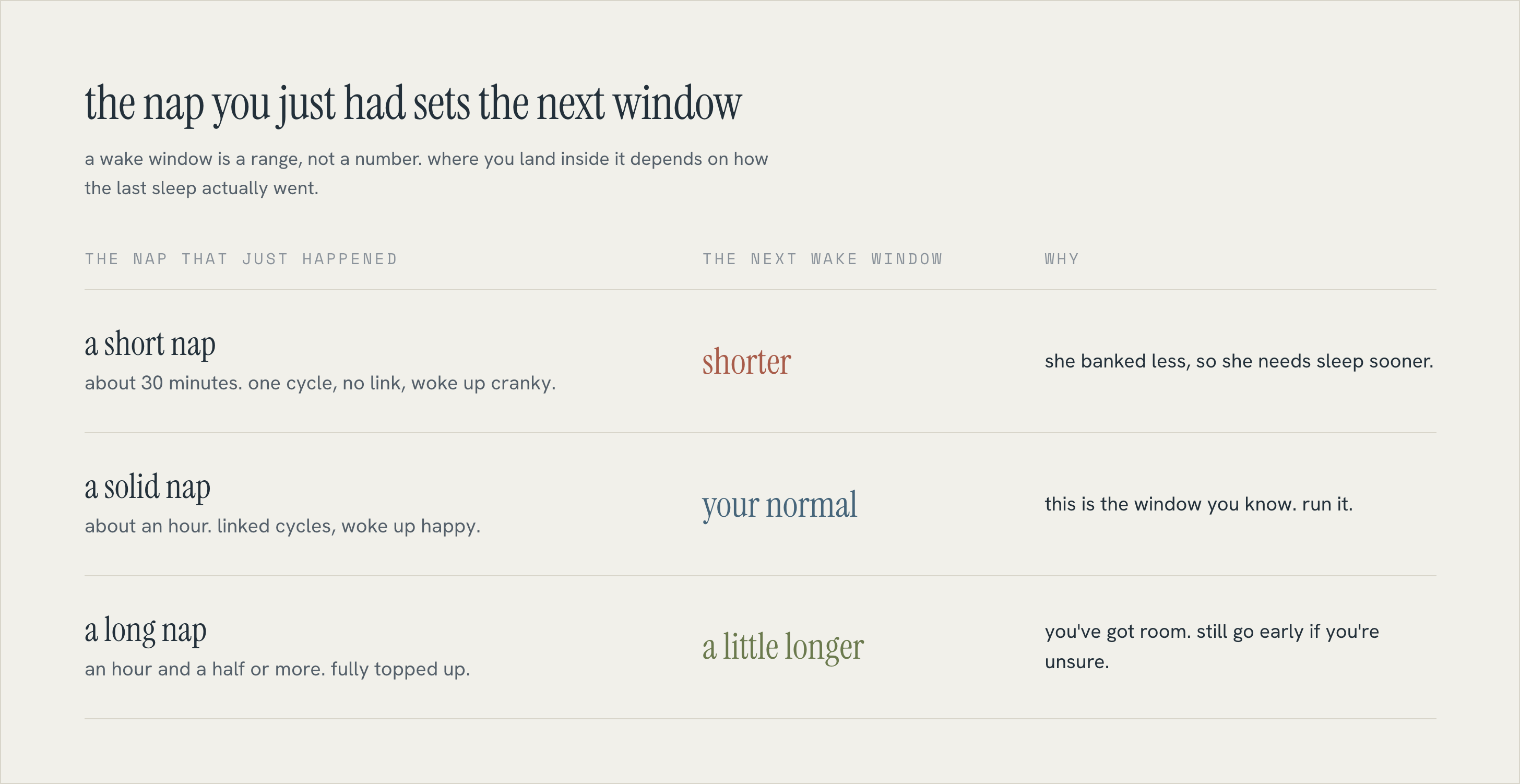
let the last nap set the next window. a short or broken nap shrinks the next window, because she banked less and needs sleep sooner. a long, deep nap buys you a little more room. you don’t run the same number every time. you read the nap that just happened and adjust off it. that’s the exact thing a chart can’t do for you.
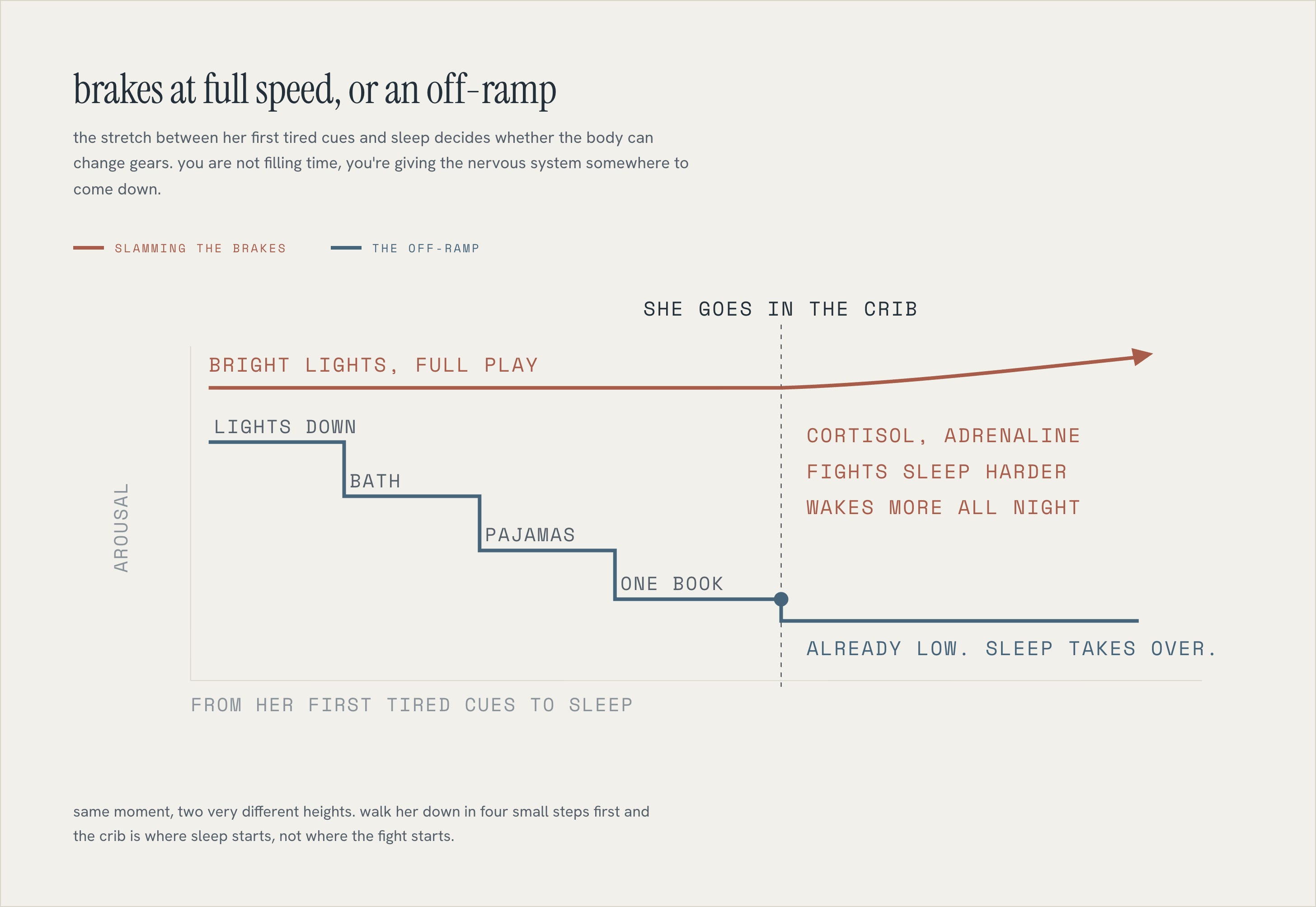
build a wind-down that actually downshifts. some overtired isn’t about the window at all, it’s about the last ten minutes before sleep being too stimulating for the body to change gears. same short sequence, same order, every time. lights low, pace slow. you’re not filling time, you’re giving the nervous system an off-ramp. a baby who goes from bright lights and play straight into the crib is being asked to slam the brakes at full speed, and slamming the brakes releases the very hormones you’re trying to keep out of the picture.
how to get an overtired baby to sleep
sometimes you catch it too late and now you’ve got a genuinely overtired, cortisol-flooded baby at 6:45 who cannot fall asleep even though sleep is the one thing she needs. this is the situation that makes parents feel like they’re losing it. here’s how to work it.
you’re not trying to get her to sleep. you’re trying to lower the arousal enough that her own sleep drive can take over. so go quieter and dimmer than feels necessary. drop all stimulation. slow your voice, slow your movements, drop the light. you’re helping the nervous system climb down off the hormones, and that takes a few minutes of real calm, not a bright, bouncy “come on, sleepy time” that keeps the engine running.
then put her down earlier than the clock says, not later. an overtired baby needs an earlier bedtime even though every instinct in your body says wait until she seems tired. she’s already past tired. waiting only digs the hole deeper.
and treat the next day as a recovery day. run everything a touch early and protect naps like your sanity depends on it, because it sort of does. one overtired night raises the baseline, so the next day is when you pay the debt back down, with earlier windows and a slightly earlier bedtime, until the tank refills. this is exactly how one rough night turns into a rough week when people treat the next day as business as usual. it’s also how you stop that from happening.
why your baby keeps getting overtired: the audit
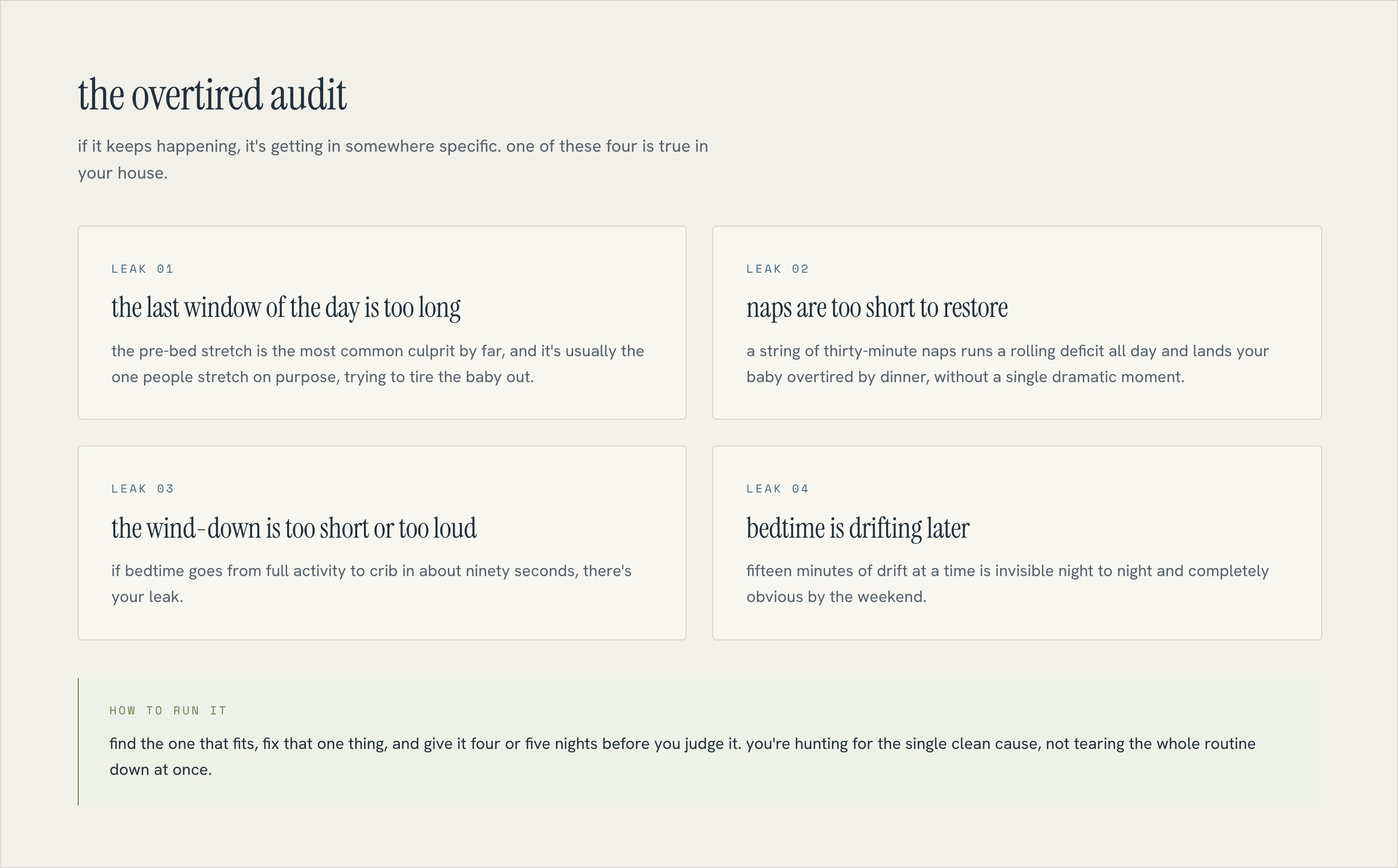
if overtired keeps happening, it’s getting in somewhere specific. run down these four and look for the one that’s true in your house.
you’re running the number, not the kid. the wake window off the chart is making the call, and your own eyes are the tiebreaker you keep overruling. if you can’t remember the last time you put her down because she looked ready instead of because the clock said so, this is your leak. for a few nights, put the chart away and move on the first calm tired sign, whatever the time.
you’re waiting for obvious. the early tells are quiet, the yawn, the stare, the ear rub, so they’re easy to sail past, and you only move once she’s clearly wired, which is already the stage after the one you wanted. if bedtime keeps starting at the meltdown instead of before it, this is your leak. treat the first yawn as now, not soon.
the wind-down doesn’t actually wind down. if the last ten minutes before sleep are still bright or busy, her body can’t change gears, and you get a fresh hit of cortisol at the exact wrong moment. if she’s calm in your arms and lights up the second she hits the crib, this is your leak. same short, dim, slow sequence every night, and start it earlier than feels necessary.
you run the same window after a short nap. a broken or short nap means she banked less and needs the next sleep sooner, but if the schedule doesn’t flex, she’s overtired by the third window without anyone doing anything wrong on purpose. if the days that fall apart are the days a nap got cut short, this is your leak. when a nap runs short, shrink the next window instead of holding the number.
find the one that fits, fix that one thing, and give it four or five nights before you judge it. you’re hunting for the single clean cause, not tearing the whole routine down at once.
the one thing to remember about an overtired baby
overtired is not a character flaw in your baby and it’s not a failure in you. it’s a hormone problem with a timing solution. you don’t fix it with more discipline. you fix it by learning to read the slide, moving earlier than feels natural, and trusting the baby over the number.
one boundary, because it matters. this is about timing and behavior, which is my lane. if your baby’s sleep is being wrecked by something that feels physical, reflux, feeding, pain, breathing, that’s your pediatrician’s call and not mine, and no amount of window-tweaking fixes a medical cause. knowing the difference is part of the job.
so before tonight: when you look at your baby wired at 7pm, are you reading it as energy, or as the tiredness standing up?
✶ and for the record, you’re doing great.
if you want the signs laid out in one place rather than a letter, that's on the blog: overtired baby signs.