


A quick note: some links below are affiliate links, which means I may earn a small commission if you buy through them — at no extra cost to you. I only ever link products I actually used with Jack and genuinely recommend.〕
People hear “sleep consultant” and picture a stopwatch, a closed door, and a hard night of crying. That’s the version of sleep training that goes viral, and it’s the version that scares the parents who need help the most.
But here’s what almost nobody tells you: the best sleep training is the one you never have to do.
I know that because I did it. Or really — I didn’t do it. My son Jack is about to turn four months old, and he’s been reliably sleeping through the night — roughly 6:30pm to 7:30am, no paci, no rocking, no feeding to sleep — since week thirteen, when I dropped his final feed. I have yet to run a single night of formal sleep training.
This isn’t luck, and it isn’t a “good baby.” It’s a method. It’s called sleep shaping, and it’s the part of this work I wish every new parent understood before they’re standing in the dark at 4am googling through tears.
So I’m doing what I’d do for any client: a real case study. The baseline, the decisions, the data. Part 1 covers the foundation — the first four months. Part 2 is coming, because there’s a twist on the horizon every parent should know about. More on that at the end.
First, the distinction nobody explains: shaping vs. training
You cannot sleep train a newborn. Structured, cry-based methods don’t belong anywhere near a baby under about four months — their nervous system isn't ready, and their feeding needs are real. I'd never train a baby that young, full stop.
But that does not mean the newborn months are a free-for-all you just have to survive until you’re “allowed” to do something.
The first four months are when you shape sleep. You’re not training anything. You’re building the foundation — the environment, the rhythms, the associations — so that if a baby ever needs formal training later, there’s barely anything left to fix. And often, like with Jack, there’s nothing left to fix at all.
That reframe is everything. Most parents treat newborn sleep as damage control and sleep training as the real event. I flip it. The newborn phase is the event. Everything after is just holding the line.
The baseline: what I started with
Jack came home with a calm temperament — I’ll be honest about that, because temperament is real and pretending it isn’t would be dishonest. But a calm baby left on autopilot still becomes a baby who needs a paci replaced eight times a night. Temperament gave me a head start. The foundation is what I built.
Here’s what I locked in from day one:
No pacifier — but hear me out, this is a me choice, not a rule. I want to be really clear: I have zero issue with pacifiers. They’re a personal decision, they bring real comfort, and they even carry safety benefits that pediatricians point to. Plenty of babies use one and sleep beautifully. For Jack, I personally chose to skip it — only because the paci is one of the most common sleep props I help families gently undo later (the 2am “replace the paci” loop is real), and I didn’t want to introduce something I might have to walk back. That’s it. If the paci works for your family, keep it — we can absolutely build great sleep around one.
Day/night differentiation, on purpose, immediately. This is the one I’d put in bold for every new parent. In the newborn weeks, I made day and night feel completely different on purpose:
Daytime naps happened out in the bright living room — lights on, normal household noise, life happening around him.
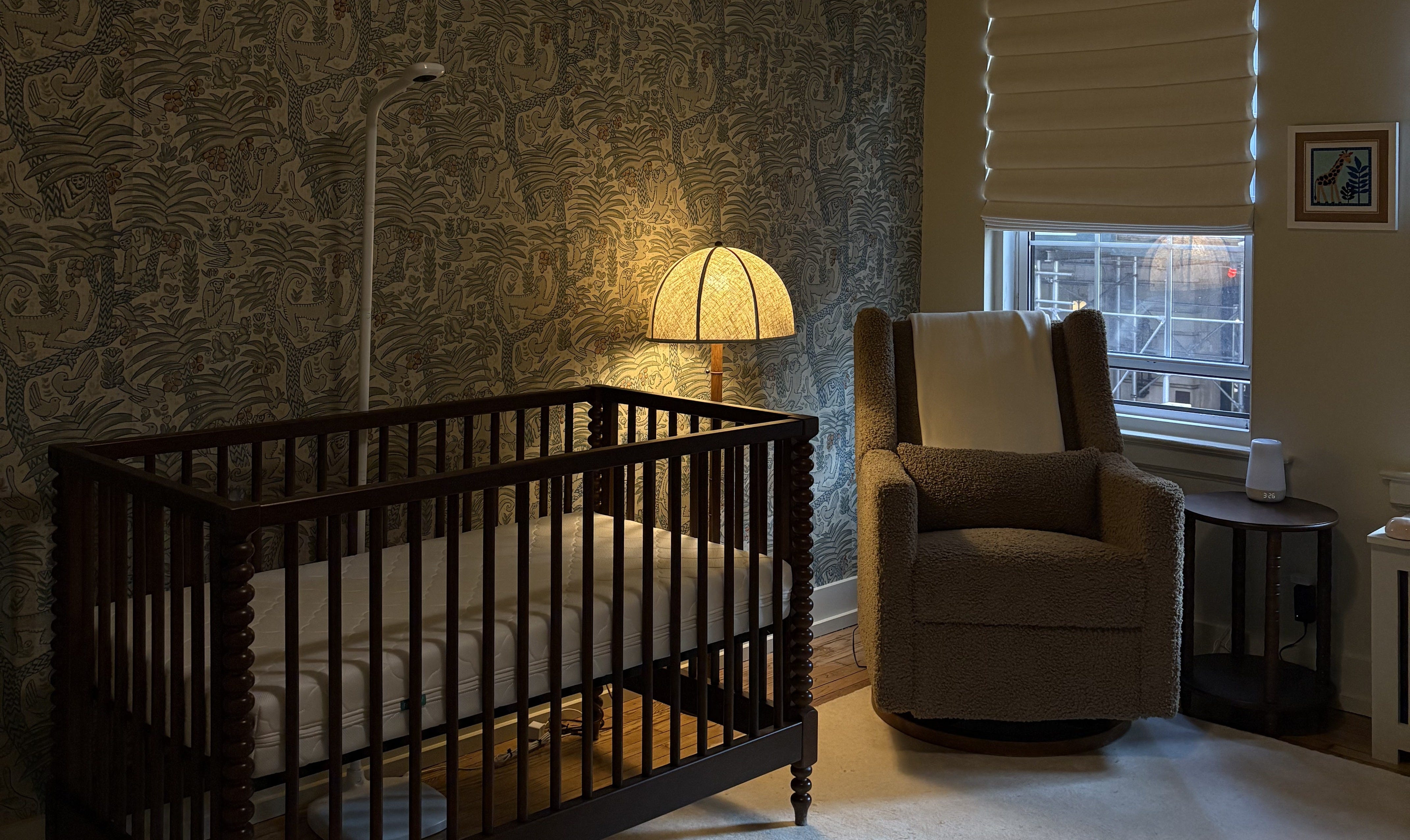
Overnight sleep was a pitch-black room and a sound machine, every single time.
Newborns are born with zero sense of day versus night. You teach it. And you teach it fast if you’re intentional.
(These days, now that the day/night distinction is locked in, his naps look different — crib, stroller, car, wherever we are. When he naps at home in his nursery, I still cue sleep the same way: blackout shades down, sound machine on. The early “bright living room” phase did its job; once the foundation is set, you can loosen the reins.)
The data: how the foundation paid off
I track everything, so I can show you the actual climb. This wasn’t an overnight flip. It was a steady, predictable build:
Weeks 1–4: Newborn life. Waking every 2–3 hours around the clock, tiny feeds, no real stretches. Exactly what a newborn is supposed to do — I wasn’t fighting it, I was laying groundwork underneath it.
Weeks 5–6: the first stretches arrived. Occasionally 4–5 hours overnight. Still inconsistent, but the day/night work was starting to show — his night sleep was beginning to outlast his day sleep. Most “he just started sleeping longer!” moments are actually built, not random.
Weeks 7–8: things clicked. Regular 6–7 hour stretches, and his first-ever 9-hour stretch showed up around week 7. This was the real turning point — the foundation catching.
Week 10: the swaddle transition. Right in the middle of this climb, I had a transition to manage. Jack had a major startle reflex, which is exactly the thing that wrecks sleep when the swaddle comes off. Here’s the key principle, and the one most parents get wrong: the reason to time the swaddle exit carefully isn’t fine-motor development — it’s the startle reflex. That’s the sleep risk.
So I bridged it. I didn’t rip the swaddle off cold turkey. I went arms-out in the swaddle for a few days first, letting him adjust to having his arms free while everything else stayed familiar, then moved him into a sleep sack. A few bumpy nights, then he settled completely.
What’s worked for other families: I used the swaddle itself as my bridge, but that won’t be the right move for every baby. For families I’ve worked with, I’ve often suggested a true transitional product like the Merlin Magic Sleepsuit to ease the jump. The principle is the same no matter the tool: don’t go from full swaddle to bare arms overnight. Bridge the startle.
Weeks 9–12: consistency. Steady 7–9 hour nights, sleeping through more and more often, with just the dream feed left in place.
That’s the part nobody posts about — the unglamorous, week-by-week climb that comes from doing the same boring, intentional things over and over. No magic night. Just compounding.
Week 13: I dropped the dream feed — and it locked in. By this point his daytime intake was solid enough to carry him through the night — he was on four full bottles a day, and that daytime volume is what makes long nights possible. You can’t starve a baby into sleeping through; you make sure the calories happen during the day so the night can be the night. Once that final feed came out, the whole thing consolidated for good.
And where he is now, a few weeks later? Fully locked in: 10+ hours every single night, a natural bedtime that settled itself at 7:21pm, and a 94 sleep score. Numbers I didn’t force — they’re just what happens when the foundation is real.
A note on numbers: Jack’s intake worked for Jack. Every baby’s feeding floor is different, and intake is a conversation for you and your pediatrician. The principle travels; the ounces don’t.
And one habit I ran relentlessly the entire time: drowsy but awake. Every chance I got, he went into the crib awake and put himself the rest of the way down. The only exception was the rare night he conked out mid-bottle. That single habit — practiced for weeks before it ever “mattered” — is why he never needed to be rocked, bounced, or fed to sleep.
The plot twist: I never actually “sleep trained” him
Here’s the part that surprises people. Ready?
There was no training event. No Ferber night. No extinction. No method.
By the time most families begin sleep training, I had already engineered the result through shaping. There was no prop to remove, no false start to fix, no 4am party to solve. The problem you’d normally hire someone like me to fix simply never developed.
Did I have a plan in my back pocket? Of course. If a problem had emerged, I’d have reached for Check and Console — going in at intervals to offer brief reassurance without picking him up, leaving while he’s still awake. It’s the gentler, hands-on approach, and it’s what suited his temperament and my tolerance.
But Check and Console was my insurance policy. I never had to cash it in.
That’s the entire thesis of how I work: proactive shaping beats reactive training every time. Do the quiet, boring, intentional work in the newborn fog, and you may never need the dramatic part at all.
Part 2 is coming — and here’s the cliffhanger
Jack is just about to hit four months. And if you know sleep, you know what’s sitting right there on the calendar.
The four-month regression.
It’s not a setback, it’s not a phase he’ll “get over” — it’s a permanent neurological rewiring of how he sleeps. His sleep cycles are about to mature into something much more adult, which means he’s about to start surfacing between cycles the way we all do. Every baby goes through it. A rock-solid foundation doesn’t make you immune — it makes you ready.
So this is the real test of everything I built in these first four months. Did the foundation hold? Did my calm sleeper get through the neurological rewiring?
That’s Part 2. Subscribe and I’ll take you through it in real time — the actual nights, the actual data, no highlight-reel nonsense.
I’m not just the consultant on this one, I’m the mom.
My newborn sleep essentials
Shop all my favorites here →
The exact gear that built Jack’s foundation:
Sound machine — the non-negotiable. Same white noise, every sleep, day one.
Swaddle — what we started in.
Sleep sack — what we transitioned to.
Merlin Magic Sleepsuit — the swaddle-transition bridge I recommend for most babies.
Bottles — what we used to hit that all-important daytime volume.
🔗 Shop all my newborn sleep favorites in one place → ShopMy
Want help with your own little one?
I work with NYC families (virtually, so really anywhere) to build exactly this kind of foundation — or to dig you out of broken nights if you’re already in the thick of it. Newborn shaping, full sleep plans for older kids, or a quick tune-up when you’re almost there.
If you’re curious whether we’d be a good fit, the first step is easy and free: fill out my quick intake form here and tell me about your little one. No pressure — just a real conversation about getting your family some sleep.
And if you’re not there yet but want more like this — subscribe. Part 2 is coming, and there’s a lot more where this came from.
A quick, important note: I’m a certified pediatric sleep consultant, and I provide sleep coaching and education — not medical advice. I’ll always tell you when something belongs with your pediatrician. Your child’s doctor is always your first call for any medical concern.