


The short version, for the tired and the skimming: hungry and tired newborns look almost identical. The thing that tells them apart isn’t a sharper eye, it’s knowing how long your baby has been awake. Cues tell you what’s happening. Wake windows tell you what it means. ✶
Everyone tells new parents to “watch for cues.” Nobody tells you that in the first few months, a hungry baby and a tired baby look almost identical. Both fuss. Both get squirmy. Both eventually cry.
So you feed the tired baby, or you try to put down the hungry one, and it doesn’t work, and it feels like you’re failing at something everyone else clearly understands.
You’re not. The cues are genuinely ambiguous at this age. The way you tell them apart isn’t a better eye. It’s knowing how long your baby has been awake.
Here’s how both pieces actually work, and how they fit together.
sleepy cues
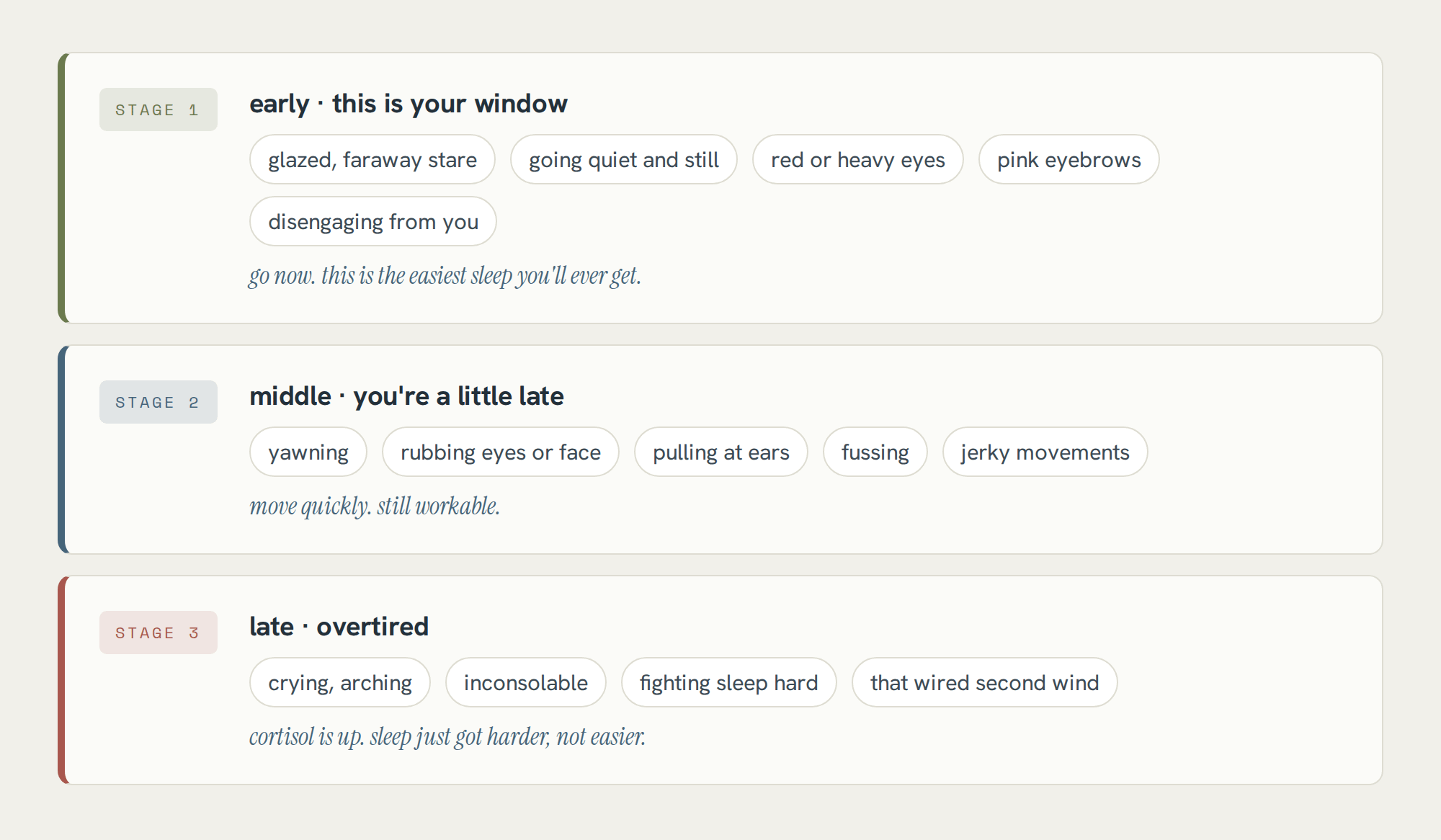
Tired cues come in stages, and the whole method is catching the early ones. By the time you see the late ones, the window has closed and you’re in overtired territory, where sleep gets harder, not easier.
early (this is your window, go now):
a glazed, faraway stare
getting quiet and still, less interested in you or the room
eyes looking red or heavy, eyebrows a little pink
slowing down, disengaging
middle (you’re a bit late, move quickly):
yawning
rubbing eyes or face, pulling at ears
fussing, jerky movements
late (you missed it, and now it’s harder):
crying, arching, inconsolable
fighting sleep hard, that wired second wind
Most parents wait for a yawn. A yawn is not the start of tiredness. It’s the middle. The real signal is that quiet, glassy disengagement that happens right before it, and it’s easy to miss because it looks like your baby is being calm and content.
✶ if you have ever thought “he seems so peaceful, I’ll put him down in a minute,” this is the moment I am talking about. that minute is the time to move!
hunger cues
Hunger has the same three-stage shape. Catch it early and feeding is calm. Catch it late and you’re trying to feed a baby too upset to latch or take a bottle.
early:
hands to the mouth
rooting, turning the head
sucking motions
fast breathing
flexing the limbs
middle:
stretching, squirming
increasing physical movement
fussing
late:
crying, turning red, frantic
too worked up to feed well
And here’s a line worth taping to your fridge: not all crying is hunger. It feels like it should be, because feeding so often stops the crying. But feeding a tired baby soothes them for the same reason rocking does, not because they were hungry.
The frustrating part: look at those middle rows. Fussing. Squirming. Restlessness. They’re on both lists. Which is exactly why “just read the cues” is incomplete advice for a newborn.

wake windows
A wake window is how long your baby can comfortably be awake between sleeps. Not a time of day. A duration.
This is the part people get backwards. A wake window is not “nap at 9:30.” It’s “about an hour after he woke up.” Newborns don’t run on a schedule, they run on elapsed time. The clock on the wall is almost irrelevant. The only number that matters is how long it’s been since your baby last woke.
And that duration is short, much shorter than most people expect, and it stretches as they grow:
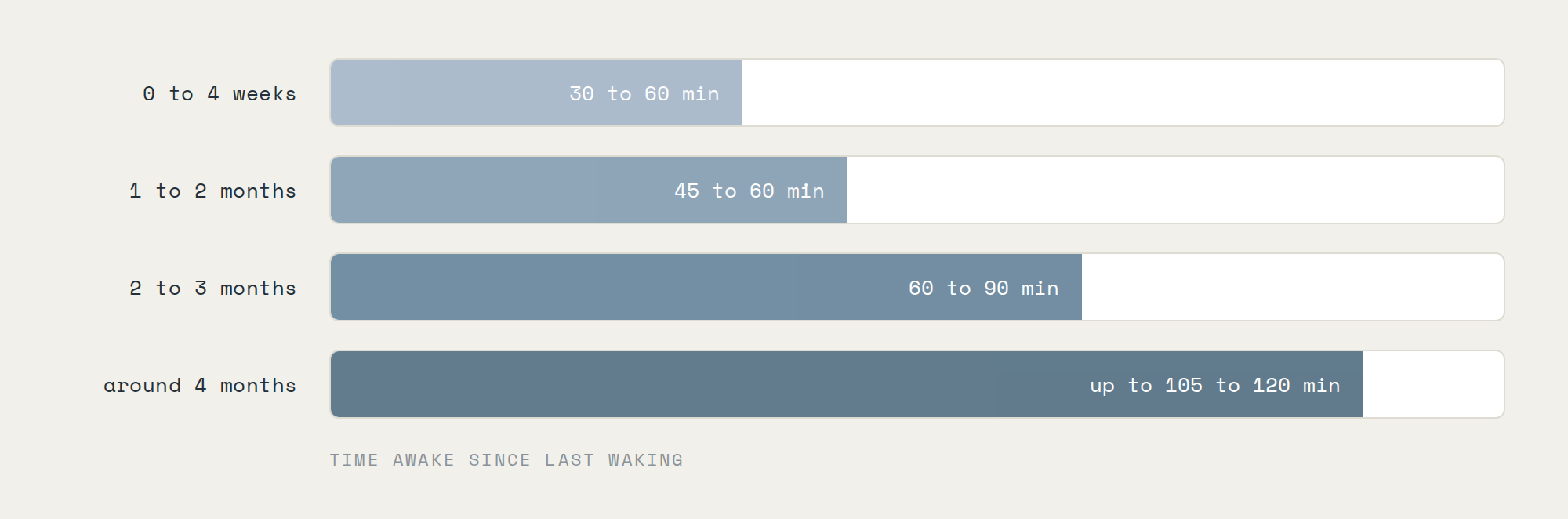
Two rules that matter more than the exact numbers:
In the newborn phase, never stretch a wake window past 90 minutes. Not to “tire him out,” not to make the next nap longer. It doesn’t work that way, and pushing past it is how you land in the overtired spiral.
Around 4 months, they graduate out of newborn windows. Sleep matures, windows stretch toward two hours, and the rules start to change. Everything before that is a different animal.
Read that again if your baby is three weeks old and you’ve been keeping him up for two hours hoping he’ll crash. That’s an entire wake window plus an hour, and it’s why bedtime is a battle.
The window starts the moment your baby wakes up, not when the nap officially ended, not when you got them out of the crib. Awake is awake, and the counter starts then.
This is also why chasing a set daily schedule at this age makes everyone miserable. A newborn who naps 25 minutes and a newborn who naps 90 minutes will need to go back down at completely different times of day, but at roughly the same elapsed time after waking. The duration is the constant. The clock times will land wherever they land.
putting them together
Here’s the part that makes it all work.
Wake windows tell you what’s coming. Cues tell you it’s here.
Use the elapsed time as your frame, and the cues as your confirmation. If your six-week-old has been awake for 50 minutes and starts fussing, that fussing is almost certainly tired, not hungry. If she woke up 15 minutes ago, ate 20 minutes before that, and starts rooting, that’s probably comfort seeking, not real hunger.
How long they’ve been awake is what tells you which cue you’re looking at. That’s the whole trick.
A practical version:
Note when your baby wakes up. Every time. Not so you can build a schedule, but so you know how long they’ve been awake at any given moment. This is the single highest-value habit in the newborn months.
Know their rough wake window for their age. From the list above.
Start watching for tired cues at about two-thirds of the way through the window. Not at the end. You want to be moving toward sleep as the early cues appear, not scrambling once they’re crying.
When you see the early cue and the elapsed time agrees, go. Don’t wait for the yawn. Don’t wait for certainty.
If the cue and the elapsed time disagree, feed first, then reassess. A newborn who just woke and is rooting is hungry. A newborn at the end of a long wake window who is rooting is often just tired and reaching for the most soothing thing they know.
Notice what’s missing from that list: any mention of what time it is. You will never once need to look at the clock on the wall. You only need to know how long it’s been.
✶ this is also why the schedule your friend swears by isn’t working for you. it was never the schedule. it was her baby’s wake windows, which happened to land at those times that day.
the honest caveat
None of this is a science you’ll perform perfectly, and you shouldn’t try. Some days the wake window is 40 minutes and some days it’s 70. Some days you’ll guess wrong, feed a tired baby, and everyone survives.
The point isn’t precision. It’s that you stop guessing blind.
✶ nobody gets this right every time. i don’t get this right every time, and it’s my job.
When you know roughly when sleep is due and what the earliest cues look like, the day goes from a series of mysterious meltdowns to something with a rhythm you can actually follow.
And when timing gets easier, everything else gets easier. Naps get longer. Bedtime gets calmer. That “he fights sleep” problem quietly stops being a problem, because it was never about fighting. It was about timing.
What cue did you learn to read that you wish someone had told you about sooner?
want help finding your baby’s windows?
Wake windows are personal, and they change fast. Figuring out your specific baby’s timing, and building the routine around it, is exactly what I do with families one on one.
The first step is easy and free. Tell me about your little one here and I’ll take a look.
And if you just want more honest, un-scary sleep science in your inbox, subscribe. There’s plenty more where this came from.
I’m a pediatric sleep consultant certified through the Center for Pediatric Sleep Management. I provide sleep coaching and education, not medical advice. Feeding and weight questions always belong with your pediatrician, who is your first call for any medical concern.